Rahu and Ketu: The Nodes, Explained
They are not planets at all, yet Rahu and Ketu carry some of the strongest meanings in a chart. Here is what the lunar nodes are, and what they are not.
 MyAstro7 Editorial
22 September 2024 · 4 min read
MyAstro7 Editorial
22 September 2024 · 4 min read
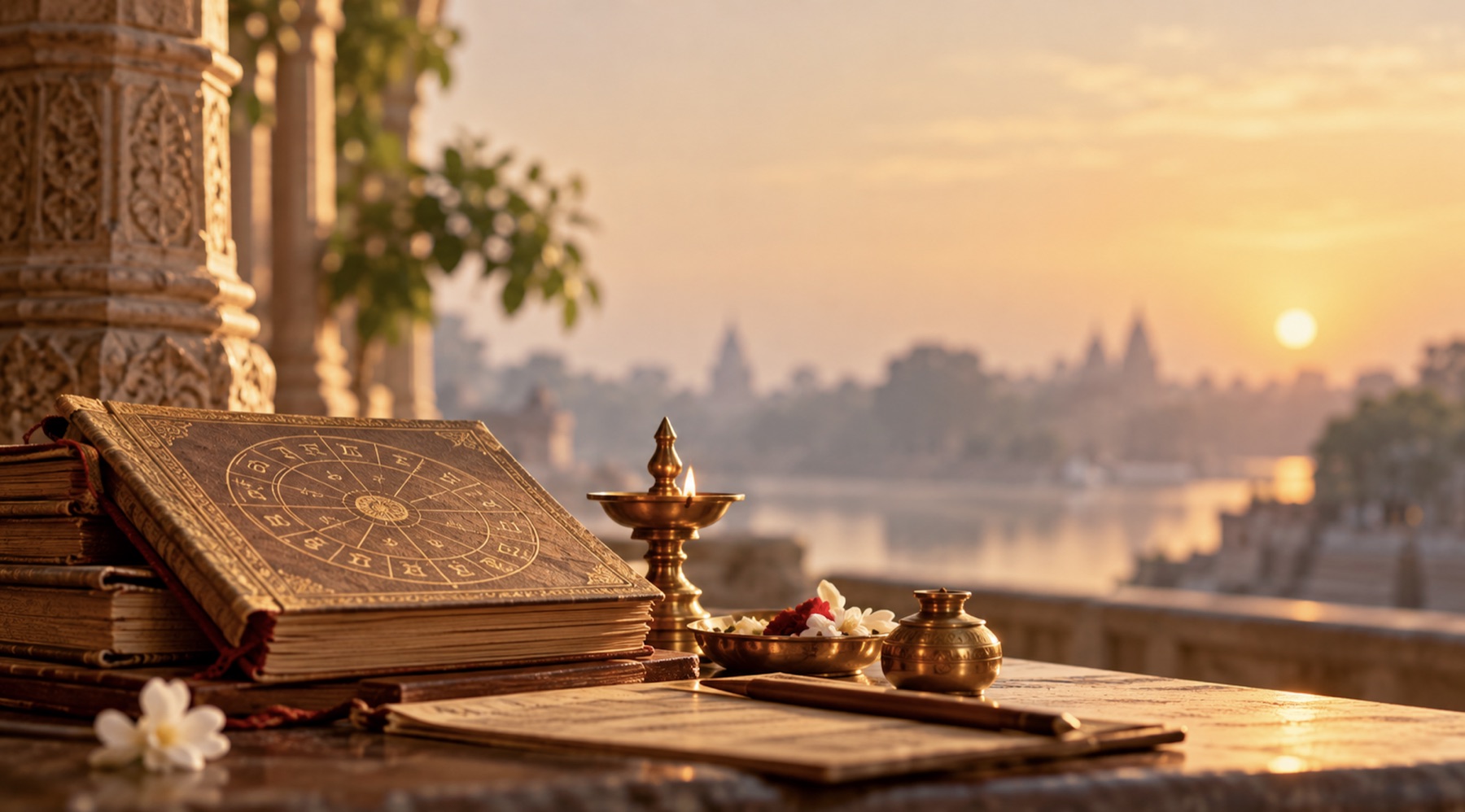
Rahu and Ketu occupy a curious place in Vedic astrology. They are counted among the nine grahas, the "seizers" or influences that make up the Navagraha, and yet they have no physical body. You cannot see Rahu through a telescope. What you can do is calculate it with great precision, because Rahu and Ketu are mathematical points: the two places where the Moon's orbit crosses the apparent path of the Sun across the sky, the ecliptic.
Rahu is the north node, where the Moon crosses moving northward; Ketu is the south node, exactly opposite. They are always 180 degrees apart, always in opposite signs, and they move backwards through the zodiac, completing a cycle in about eighteen and a half years. Eclipses occur when the Sun and Moon come together near these points, which is why the old myths describe Rahu and Ketu swallowing the luminaries.
The story behind the symbols
The Puranic account tells of the churning of the ocean, when the gods and the asuras worked together to draw out amrita, the nectar of immortality. An asura named Svarbhanu disguised himself and drank a portion. The Sun and Moon recognised him and Vishnu severed his head with the Sudarshana chakra. Having tasted the nectar, neither part died. The head became Rahu, the body Ketu.
The story is more than ornament. It gives the nodes their character. Rahu is the head without a body: appetite, ambition, restlessness, fascination with the new and the foreign, a hunger that is never quite satisfied. Ketu is the body without a head: detachment, intuition, past skill, a tendency to let go, and in its higher expression, spiritual insight.
How they are read in a chart
Because they always sit opposite each other, the nodes form an axis across two houses, and that axis is read together. The house holding Rahu often shows an area of life where a person feels drawn, sometimes obsessively, towards growth and experience. The house holding Ketu often shows an area where they already have a kind of ease, or where they feel oddly indifferent.
Like the other grahas, the nodes also run their own dasha periods: eighteen years for Rahu and seven for Ketu in the Vimshottari system. These are often periods of change. A Rahu dasha can bring travel, unconventional opportunities, sudden rises and the occasional sense of being out of one's depth. A Ketu dasha may bring withdrawal, simplification or a turn towards inner questions.
The nodes describe a direction of travel in a life, not a destination fixed in advance.
The nodes also take on the qualities of the planet that rules the sign they occupy and of any planets conjoined with them, which is why two people with Rahu in the same house can have very different experiences.
Kaal Sarp and other alarms
You may have been told you have Kaal Sarp Dosha, a configuration in which all seven visible planets fall on one side of the Rahu–Ketu axis. It is worth knowing that this combination is not described in the major classical texts such as Brihat Parashara Hora Shastra, that its definition varies between practitioners, and that many accomplished, contented people have it. It is not a reason for fear, and certainly not a reason to spend large sums in a hurry.
Similarly, Rahu in a particular house is not a curse. Every chart has Rahu somewhere. The meaningful question is how the node relates to the rest of the chart and to the current period of life.
Living with the axis
A useful, practical way to think about the nodes is as a balance to be kept. Rahu's ambitions are healthier when they are tempered by some of Ketu's discernment; Ketu's detachment is healthier when it does not become avoidance. If a period of your life feels unsettled, routines, honest counsel and simple disciplines such as regular prayer or meditation help far more than anxiety does.
If you would like to understand the nodal axis in your own chart, a practitioner can show you which houses it spans and when its periods fall. That knowledge is most useful not as a warning, but as a way of recognising patterns you may already have noticed in yourself.
Vedic counsel and ritual are traditional and complementary practices — they sit alongside professional medical, legal and financial advice, never as a substitute for it.