
Lagna: Why Your Rising Sign Matters More Than Your Sun Sign
Newspaper horoscopes use the Sun sign. Vedic astrology starts from the lagna, which changes every two hours. Why that difference matters, and why birth time is key.
 Jyotish Meenal Joshi
5 August 2025 · 3 min read
Jyotish Meenal Joshi
5 August 2025 · 3 min read

Many people who come to me for the first time introduce themselves by their Sun sign: "I'm a Leo", "I'm a typical Virgo". In Vedic astrology this is rarely where we begin. The starting point of a jyotish reading is the lagna, the rising sign, and understanding why explains much about how the tradition works.
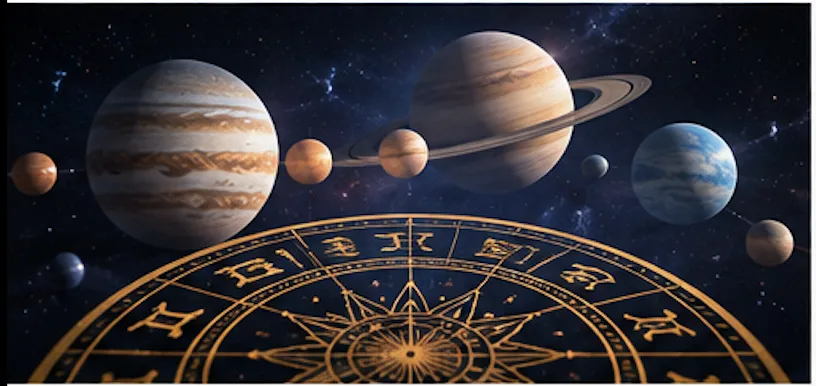
The lagna, also called the ascendant, is the sign of the zodiac rising on the eastern horizon at the exact moment and place of birth. As the Earth turns, all twelve signs rise in turn over roughly twenty-four hours, so each sign occupies the horizon for about two hours on average, though some rise faster than others depending on latitude.
Why the lagna comes first
The Sun stays in a sign for about a month, so everyone born in that month shares a Sun sign. The lagna changes every couple of hours, so it distinguishes people born on the same day. More importantly, the lagna is the reference point for the entire chart. It becomes the first house, and every other house, the second for resources, the seventh for partnership, the tenth for career and so on, is counted from it.
This means the same planetary positions can mean quite different things for two people born a few hours apart. Jupiter in Cancer might fall in one person's tenth house, describing work and standing, and in another's first, describing temperament and the body. Without the lagna, a chart has planets but no structure.
The lagna itself
The lagna and its ruling planet, the lagnesh, describe the person's constitution, temperament and general approach to life in the tradition's reading. A Cancer lagna, ruled by the Moon, is often described as sensitive and protective; a Capricorn lagna, ruled by Saturn, as patient and responsible. These are traditional associations, not character verdicts, and they are always modified by the planets in and aspecting the first house.
The lagna is not one more sign in your chart; it is the place from which the whole chart is read.
A note on the Sun sign
There is a further wrinkle. Vedic astrology uses the sidereal zodiac, measured against the fixed stars, while most Western horoscopes use the tropical zodiac, tied to the seasons. The difference, known as the ayanamsa, is currently around twenty-four degrees. As a result, most people's Sun sign in a Vedic chart is one sign earlier than in a Western one. Someone who is a Leo in a magazine is often a Cancer in jyotish. Neither is wrong within its own system, but it explains why people are sometimes confused.
In Indian practice, the Moon sign, or rashi, is also widely used, particularly for transits and for marriage matching. But the lagna remains the frame within which both are read.
Why birth time matters
Because the lagna changes so quickly, an accurate birth time is essential. An error of even fifteen or twenty minutes can shift the lagna to the next sign if the birth was near a boundary, and that changes the whole house structure. Hospital records or family notes are best; approximate times can sometimes be refined by a practitioner through a process called birth time rectification, which tests the chart against known life events.
If you have never seen your own lagna, the first step is simply to find your most accurate birth time and place. Everything else in a reading builds from there.
Vedic counsel and ritual are traditional and complementary practices — they sit alongside professional medical, legal and financial advice, never as a substitute for it.