Agni: Why Fire Sits at the Centre of Vedic Ritual
The Rigveda opens with a hymn to fire. Why Agni became the messenger, the witness and the mouth of the gods in Vedic ritual.
 Pandit Naveen Trivedi
21 January 2026 · 3 min read
Pandit Naveen Trivedi
21 January 2026 · 3 min read

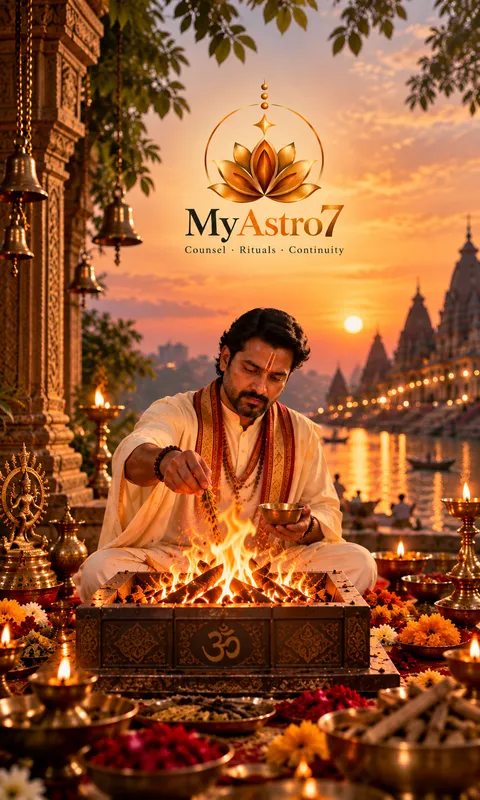
The very first word of the Rigveda is agnim. The first hymn praises Agni, fire, as the priest of the sacrifice and the bringer of its rewards. From that opening line onward, fire sits at the centre of Vedic ritual, and it still does. Most of the havans I perform in Ahmedabad, whether for a new business or a family occasion, are organised around a small square fire pit, the kunda.
It is worth asking why. Why fire, and not water, or earth, or a carved image?
The messenger between worlds
In the Vedic view, Agni is the intermediary. Offerings placed into the fire are carried by Agni to the deities to whom they are dedicated. This is why Agni is called the mouth of the gods and the havya-vahana, the carrier of oblations. The fire transforms a physical substance, ghee or grain, into something that rises and disperses.
There is a simple observation underneath this. Fire is the one element that visibly changes what it receives. Food becomes heat, solid becomes smoke, the heavy becomes light. Ritual thought built on that observation.
Witness and household
Agni is also the witness, sakshi. In a wedding, the couple take their vows in the presence of the fire, and the marriage is understood to be witnessed by Agni. In other rites, the fire is the presence before whom an intention is declared.
In older Vedic households, the sacred fires were kept continuously. A householder might maintain three fires, the garhapatya, ahavaniya and dakshinagni, each with its own role and position. This continuous fire was the centre of domestic religious life, and its maintenance was a daily discipline. Very few households keep these fires today, but the idea that a home has a ritual centre survives in the daily lamp.
Fire is the one element that visibly changes what it receives, and Vedic ritual was built on that observation.
How a havan works
In a typical havan, the kunda is prepared and the fire is kindled, traditionally from a sacred source or by friction, and today usually with camphor. The fire is invoked and given a name appropriate to the occasion, since Agni is called by different names in different rites. Samidha, sticks of specified wood, are offered, followed by ghee and other samagri, each oblation accompanied by a mantra ending in svaha, the call that marks the offering.
The purnahuti, the final full offering, closes the rite. The ash is later taken by some as a blessing and the remainder returned respectfully to earth or water.
Practical and honest notes
A havan is an act of worship with a long history, and many families find it focusing and meaningful. It is not a purification device for air quality or a cure for illness, as is sometimes claimed, and I would rather not see it sold that way. In flats and offices, safety matters: use a proper kunda, keep the fire small, ensure ventilation, and keep water nearby. Many buildings now have rules about open flames, and they should be respected.
If you are arranging a havan, ask your priest which form of Agni will be invoked and why, make sure the ghee and wood are good quality, and give everyone present the chance to make at least a few offerings themselves. The rite is meant to be done together, around the fire, not watched from across the room.
Vedic counsel and ritual are traditional and complementary practices — they sit alongside professional medical, legal and financial advice, never as a substitute for it.