
Puranas and Itihasas: How the Stories Teach
The Mahabharata does not tell you what to do. It shows you people who had to decide. That is the method, and it is a deliberate one.
 MyAstro7 Editorial
14 January 2026 · 3 min read
MyAstro7 Editorial
14 January 2026 · 3 min read

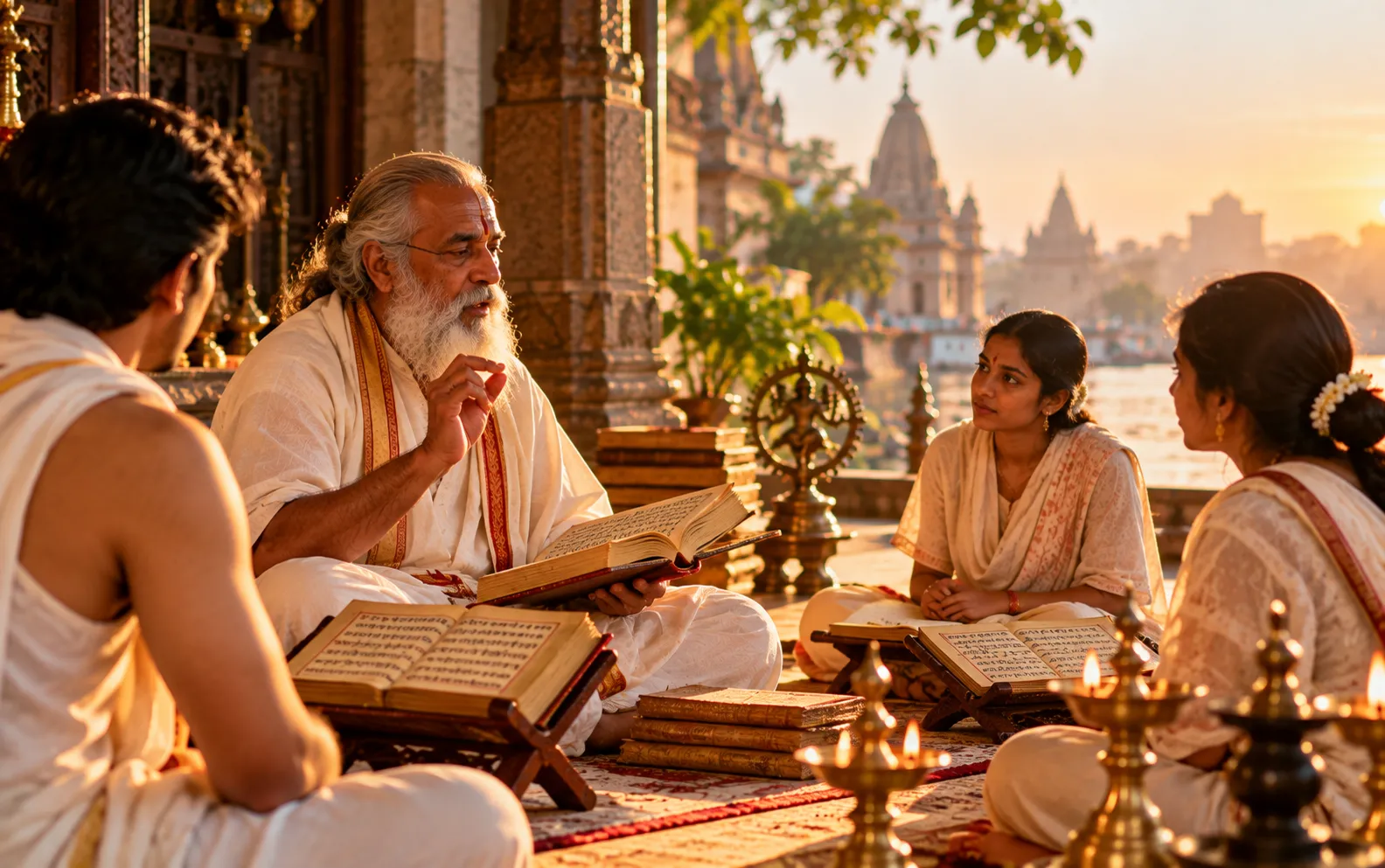
Ask someone what Hinduism teaches about duty, grief or loyalty and they will rarely quote a verse. They will tell you a story: Rama's exile, Karna's choice, Savitri following Yama, Prahlada refusing to be frightened. Most of what people actually carry of the tradition reaches them through narrative, not doctrine.
That narrative comes from two bodies of literature, the Itihasas and the Puranas. They work differently from the Vedas, and it helps to know how.
Two kinds of story literature
Itihasa means, roughly, "thus indeed it was". The term covers the two great epics, the Ramayana of Valmiki and the Mahabharata attributed to Vyasa. They present themselves as history in the older sense: accounts of a lineage and its crises, told so that later generations might learn from them.
The Puranas, of which eighteen are counted as major, are broader. Classically a Purana is said to cover five subjects: creation, dissolution and re-creation, the genealogies of gods and sages, the great cosmic ages, and the histories of royal dynasties. In practice they also contain pilgrimage guides, ritual instructions, hymns and a vast number of tales. The Satyanarayan katha recited in so many homes comes from the Skanda Purana; much of the lore of Krishna's childhood is from the Bhagavata Purana.
Both belong to smriti, "that which is remembered", as distinct from shruti, the Vedic texts regarded as heard or revealed. Smriti was always expected to be retold, adapted and argued over.
Teaching through dilemma
The striking thing about the epics is how rarely they resolve their hardest questions. Yudhishthira's half-truth at Kurukshetra, Bhishma's vow, Draupadi's question in the assembly hall about whether a man who has lost himself can still wager his wife: these are left standing, debated by the characters themselves. The Mahabharata famously says that dharma is subtle. It means this literally. Right action depends on circumstance, relationship and consequence, and the story trains the reader to weigh them.
The stories do not tell you what to do; they show you people who had to decide, and let you sit with what it cost them.
The Puranas often teach more directly, through devotion and its rewards, but even there the method is to show rather than instruct. A child listening to the story of Dhruva learns about perseverance without a single sentence of moral advice.
Reading them well today
Two cautions are worth keeping. First, these texts were composed and revised over many centuries, and they carry the social assumptions of their times, including about caste and women, that a thoughtful reader need not accept. The tradition itself contains voices that questioned them. Second, a story used to frighten someone into a ritual, "this happened to a man who neglected his ancestors", is being used against its own spirit. The stories were meant to deepen judgement, not to replace it.
If you would like to read rather than only hear these works, begin with a good abridged translation of the Mahabharata, then a single book of the Bhagavata Purana, ideally read aloud with family over several evenings. Pause when a character faces a hard choice and ask what each person at the table would have done. That conversation is very close to how the stories were always meant to be used.
Vedic counsel and ritual are traditional and complementary practices — they sit alongside professional medical, legal and financial advice, never as a substitute for it.