Upanayanam: The Sacred Thread
The thread is the visible part. Upanayanam is really about a student being brought to a teacher, and the discipline that follows.
 Acharya Vishwanath Iyer
22 September 2024 · 3 min read
Acharya Vishwanath Iyer
22 September 2024 · 3 min read

Upanayanam literally means leading near: the child is led near to a teacher, and through the teacher to the study of the Veda. The sacred thread, the yajnopavita, worn across the left shoulder, is what most people remember, but in the classical understanding the thread is a sign of a commitment rather than the commitment itself.
In South India, where I have performed this rite for many years, upanayanam remains a living ceremony, often held between the ages of seven and twelve. Families take it seriously and plan for it months in advance. Elsewhere it has sometimes been compressed into a short morning before a wedding. Both situations deserve an honest description of what the rite is meant to carry.
The structure of the ceremony
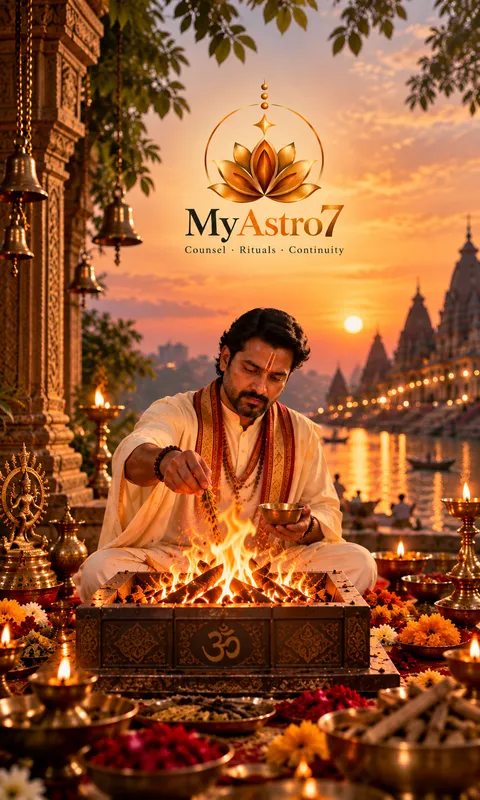
The day usually begins with a final meal the boy shares with his mother, a moving moment that marks the end of early childhood. There is a havan, the fire offering, and the father or acharya invests the boy with the thread while specific mantras are recited. A girdle of munja grass, a staff and sometimes a deerskin or its substitute are given, each symbolising the austere life of a student.
The centre of the ceremony is the brahmopadesha, the moment when the teacher whispers the Gayatri mantra to the student for the first time, often under a cloth so that the transmission is private. From this point the student is expected to perform sandhyavandanam, the twilight prayers, daily. Afterwards, the boy goes through bhiksha, receiving alms first from his mother, a reminder that learning is received, not owned.
What the thread asks of the wearer
The yajnopavita has three strands, often explained as three debts: to the sages who preserved knowledge, to the ancestors, and to the gods. Wearing it implies a willingness to study, to remember those who came before, and to live with some restraint. Families sometimes treat the thread as a badge of status. The texts treat it as a responsibility.
The thread is changed periodically, most commonly on Avani Avittam (Upakarma) each year, when wearers renew their commitment. It is also changed after births and deaths in the family. These are small, regular disciplines, and they are where the real meaning of upanayanam lives.
The thread is put on in a morning; what it stands for has to be put on every day.
Honest expectations
Upanayanam does not make a child wise, fortunate or successful. It places a child in a relationship with learning and gives him a daily practice. Whether that practice continues depends on the family, the teacher and the child himself. Many people receive the thread and never perform sandhya again; the rite is not a failure in such cases, but its purpose has not been fulfilled.
There are also questions families now ask openly: about girls receiving upanayanam, which some texts and some modern traditions support; about adults who missed it as children; and about doing it abroad. These are reasonable questions and they have thoughtful answers within the tradition. A practitioner should discuss them with you rather than dismiss them.
If you are preparing a child, begin teaching the Gayatri's pronunciation and the basic sandhya sequence a few weeks before the ceremony, so that the brahmopadesha is not his first encounter with it. Choose a teacher who will remain available afterwards, even by phone. And plan the day so that the boy is rested; a tired child cannot listen, and listening is the whole point.
Vedic counsel and ritual are traditional and complementary practices — they sit alongside professional medical, legal and financial advice, never as a substitute for it.