
Griha Pravesh for a Joint Family Home
When three generations move into one home, griha pravesh has to account for many charts, many hopes and one doorway. A practical guide from Pune.
 Acharya Satish Kulkarni
29 January 2025 · 3 min read
Acharya Satish Kulkarni
29 January 2025 · 3 min read

Griha pravesh, the ceremonial first entry into a new home, is among the most common rituals I perform in Pune. When the home is for a single couple, the arrangements are fairly simple. When it is a joint family home, grandparents, two or three married sons, their spouses and children, the questions multiply. Whose chart sets the muhurat? Who enters first? How do we fit everyone's relatives into a three-bedroom flat?
These are good questions, and the tradition has sensible answers to most of them.
Choosing the muhurat
The muhurat for griha pravesh considers the tithi (lunar day), nakshatra, weekday and lagna (the rising sign at the time of entry). Certain periods are traditionally avoided, such as Kharmas, Chaturmas in many communities, and the months when Jupiter or Venus are combust, too close to the Sun to be visible.
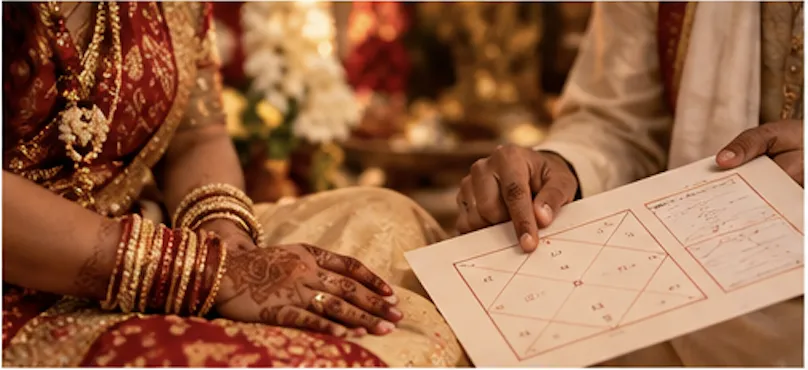
In a joint family, the muhurat is usually chosen with reference to the head of the household, often the eldest male or female member, in whose name the sankalpa is taken. A careful practitioner may also glance at the charts of the other adult members to avoid a day that sits badly with someone running a difficult period, but it is neither necessary nor practical to find a moment ideal for every chart.
Who enters first
Traditionally, the head of household and their spouse enter first, the woman of the house carrying a kalash (a pot of water topped with mango leaves and a coconut) and stepping in with the right foot. In joint families this honour often goes to the grandparents, with the next generations following in order. Some families have the eldest daughter-in-law kick over a vessel of rice at the threshold, a regional custom symbolising abundance.
It is worth agreeing this in advance. Small questions of precedence can cause real hurt on the day if left unspoken.
In a joint family, griha pravesh blesses a building, but it also renews an agreement to live together with patience.
The rites themselves
A typical griha pravesh includes Ganesh puja to remove obstacles, a Vastu puja honouring the Vastu Purusha, the presiding spirit of the site, a Navagraha puja to the nine planetary deities, and a havan. Milk is often boiled over in the new kitchen, symbolising plenty. Many families also hold a Satyanarayan katha that evening or soon after.
In a joint home, it is a kind gesture to have each household within it offer something: one couple sponsors the havan, another arranges the meal, the grandchildren draw the rangoli. Shared effort helps everyone feel the home is theirs.
Vastu and practical living
Families often ask me about Vastu, the traditional science of spatial arrangement. Vastu can offer useful principles about light, ventilation and the placement of the kitchen and puja room. But in a city flat, perfect Vastu is rarely possible, and it is unwise to argue over which son gets the north-east bedroom. Comfort, privacy for each couple and access for elderly members matter more.
If your family is moving into a shared home, sit together first and agree who leads the entry, who sponsors which part of the ceremony, and how the space will be shared. With those decisions made, a practitioner can choose the muhurat and guide a griha pravesh that blesses the whole household.
Vedic counsel and ritual are traditional and complementary practices — they sit alongside professional medical, legal and financial advice, never as a substitute for it.