
Kundali Matching Conversations Between Families
A matching score is the start of a conversation, not its end. How families can discuss kundali compatibility without fear, pressure or hurt feelings.
 Jyotish Anand Vyas
5 June 2026 · 3 min read
Jyotish Anand Vyas
5 June 2026 · 3 min read
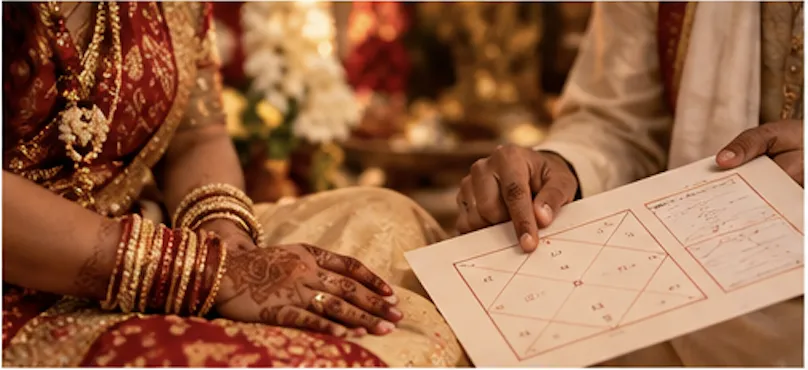
Kundali matching is one of the most common reasons families consult a jyotishi, and one of the most emotionally delicate. Two families who may have only just met are asked to share birth details, compare charts, and then talk about the results. Done carelessly, it can end a promising alliance over a number. Done well, it can deepen understanding between two households.
I have sat in many such conversations. What follows is what I have learnt about making them fair and humane.
What matching actually looks at
The best-known method is Ashtakoota milan, which compares the two janma nakshatras (the lunar mansions occupied by the Moon at birth) across eight factors, or kootas, giving a score out of thirty-six. Eighteen is commonly treated as the threshold. The factors consider temperament, mutual attraction, health and lineage-related compatibility, among other things.
A careful practitioner does not stop there. They will also look at each person's lagna and seventh house (the house of partnership), the condition of Venus and Jupiter, Mangal dosha (the traditional concern about Mars in certain houses), and the dasha periods each person is running around the time of marriage.
Why a score alone misleads
A high score does not guarantee a happy marriage, and a modest score does not doom one. Some koota mismatches are traditionally considered cancelled by other factors in the charts. Mangal dosha, often spoken of with alarm, is present in a large share of all charts and is frequently neutralised when both partners have it or when other placements mitigate it.
The single most harmful thing I see is a family receiving a number from a free website and treating it as a verdict. The number is a starting point for interpretation, nothing more.
Matching should help two families understand each other better, not give one of them a polite excuse to say no.
How to hold the conversation
Agree beforehand who will consult, and whether both families will hear the reading together or separately. Joint consultations can work well when there is goodwill; they reduce suspicion that one side has shaped the result.
Speak about findings as tendencies, not faults. Saying the charts suggest the couple may need patience in communication is honest and useful. Saying the girl's chart is bad is neither. Remember that a real young person sits behind each chart, often listening.
And let the couple speak. Their own sense of each other, their values and their ability to resolve disagreement, matters more than any koota. In many families today the couple already know each other well; the matching then becomes a blessing and a reflection rather than a gate.
When concerns do arise
Sometimes a reading does raise a real point for reflection. When that happens, a good practitioner explains it plainly, suggests what it may mean in daily life, and, where appropriate, offers modest traditional remedies such as a specific puja or the observance of certain fasts. They should never use fear to sell an expensive ritual, and they should never pronounce that a marriage will fail.
If your family is approaching a matching consultation, agree in advance that the result will be one input among several. Bring both charts with accurate birth times, sit together if you can, and ask the practitioner to explain what each finding means in ordinary terms.
Vedic counsel and ritual are traditional and complementary practices — they sit alongside professional medical, legal and financial advice, never as a substitute for it.