

Navagraha Shanti: What It Addresses
Navagraha Shanti is a ritual of balance offered to the nine planetary deities. What it involves, when it is traditionally performed, and what it cannot promise.
 Acharya Vishwanath Iyer
6 April 2026 · 3 min read
Acharya Vishwanath Iyer
6 April 2026 · 3 min read
Navagraha Shanti is one of the most frequently requested rituals in India, and one of the most frequently misunderstood. It is often presented as a cure for whatever is going wrong: a delay in marriage, a difficult year, a troubling astrological report. In the tradition it is something quieter and more coherent than that, a ritual of propitiation and balance offered to the nine grahas.
The Navagraha are the Sun (Surya), Moon (Chandra), Mars (Mangal), Mercury (Budha), Jupiter (Guru or Brihaspati), Venus (Shukra), Saturn (Shani), and the two lunar nodes, Rahu and Ketu. In temple worship and household ritual alike, they are regarded as deities who carry out the workings of karma and time. Shanti means peace. A Navagraha Shanti seeks peace with, and among, these influences.
When it is traditionally performed
In the classical understanding, a shanti ritual is appropriate at transitions and at times when a chart shows difficult planetary periods. Families commonly arrange one at the start of a demanding dasha, such as a Saturn or Rahu period; during Sade Sati; before or after a wedding or griha pravesh; when beginning a new venture; or at a significant birthday, such as the sixtieth, Shashtiabdapoorthi, in South Indian practice. Many families also perform it simply as an annual observance.
Note what these occasions have in common. They are thresholds. The ritual is a way of beginning a new period with acknowledgement and humility, rather than an emergency measure.
What the ritual involves
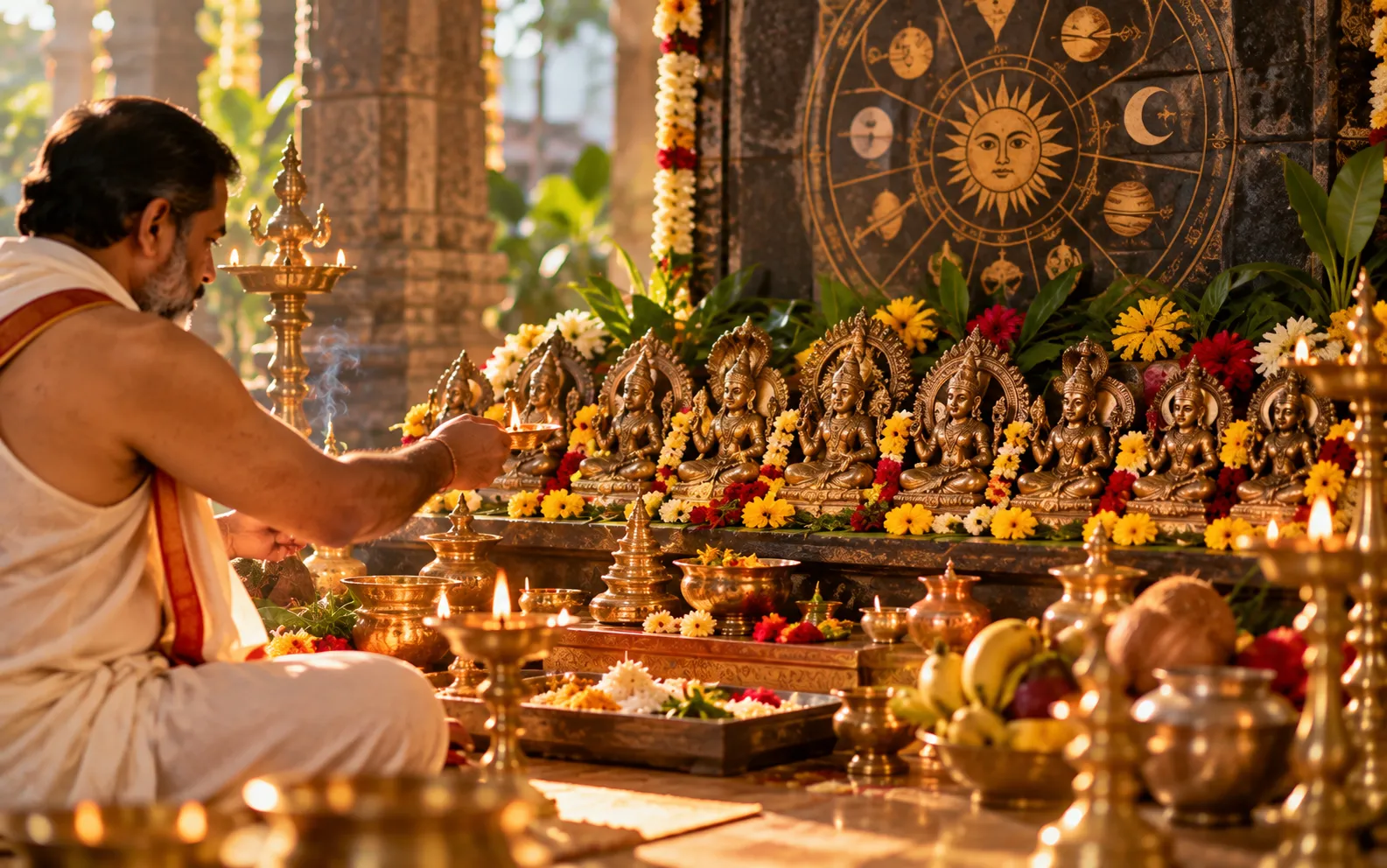
The ritual opens with Ganesh puja, the sankalpa (the statement of the family's names, gotra and purpose) and the worship of a kalash. A mandala is prepared, often on a raised platform, with nine sections arranged in a traditional pattern, the Sun at the centre, each graha in its own direction and associated colour. Each graha is invoked with its own mantra, along with its adhidevata and pratyadhidevata, the presiding deities associated with it.
A havan follows, with offerings into the sacred fire. Traditionally, each graha has its own samidha, a wood from a specific tree, such as arka for the Sun, palasha for the Moon, khadira for Mars, ashwattha for Jupiter and shami for Saturn. Grains associated with each planet are offered too. Recitations of the graha mantras, sometimes thousands of times by several priests, form the heart of the ritual. It concludes with purnahuti, the final offering, aarti, and the giving of dana, gifts or charity associated with the grahas.
A shanti is not a bargain with the planets; it is a disciplined act of humility at a moment of change.
What it does not do
A Navagraha Shanti does not cancel a dasha, rewrite a birth chart or guarantee a particular outcome, and a responsible priest will not claim that it does. Nor is it a substitute for medical treatment, legal advice or sound financial decisions. In the tradition it supports a person's own efforts with steadiness and devotion; it does not replace them.
It is also worth being cautious of urgency. Rituals that must be booked within days at a high price, because of an alarming reading, are not in keeping with how this ritual has been understood.
Arranging one thoughtfully
If you are considering a Navagraha Shanti, ask the priest to explain which grahas are being emphasised and why, how many recitations will be performed, and what the samagri includes. A muhurat can be chosen for it, but many priests also perform it on days associated with particular grahas. Take part rather than simply sponsoring: sit for the sankalpa, make the offerings, and give the dana with your own hands. The value of the ritual lies as much in that participation as in the mantras themselves.
Vedic counsel and ritual are traditional and complementary practices — they sit alongside professional medical, legal and financial advice, never as a substitute for it.