
NRI Families: Keeping Rituals Across Time Zones
Should Diwali puja follow Indian time or local time? Practical guidance for families abroad on muhurat, samagri and taking part in rituals in India.
 Pandit Vikram Aditya Singh
18 July 2025 · 3 min read
Pandit Vikram Aditya Singh
18 July 2025 · 3 min read

A large part of my work is with Indian families living abroad, in London, Toronto, Dubai, Singapore, New Jersey. They want to keep their traditions, often more fiercely than relatives in India, but they face practical questions that the old texts did not anticipate. Which time zone does a muhurat follow? Can a puja in Varanasi be offered on our behalf? Where do we find a priest in Melbourne?
These questions have reasonable answers, and families need not feel that living abroad makes their practice less authentic.
Muhurat follows where you are
The Hindu calendar is astronomical. The tithi (lunar day), nakshatra and sunrise all depend on the position of the Sun and Moon relative to a particular place. So the festival day and its muhurat should be calculated for the city where the ritual is actually performed, not copied from an Indian panchang (almanac).
This is why Diwali, or Ekadashi, can occasionally fall on different dates in India and North America. It is not an error; the lunar day begins at a different local moment. Many temples abroad publish locally calculated calendars, and a practitioner can calculate a specific muhurat for your city with ease.
When a ritual is performed in India for you
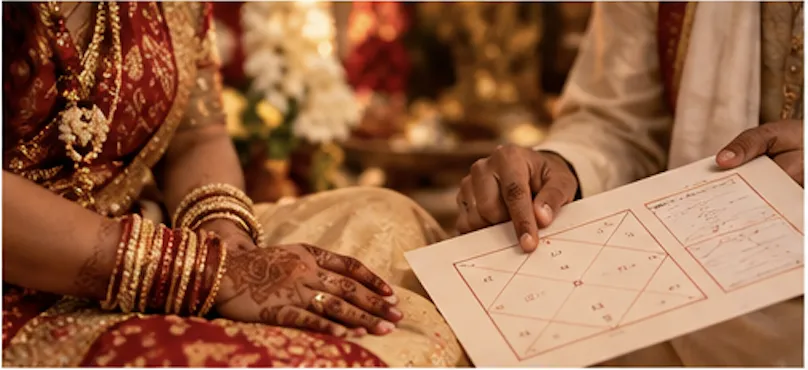
Some rites are traditionally tied to particular places: pind daan at Gaya or Haridwar, certain pujas at Kashi or Rameswaram. Families abroad often arrange for these to be performed by a priest on their behalf. In this case the priest takes a sankalpa (the formal statement of intention) naming the family, their gotra (the ancestral lineage) and the purpose of the rite, and performs it at the auspicious local time in India.
It is worth asking for the ceremony to be streamed live or recorded, so that the family can watch and offer their own prayers at the same moment, even if it is the middle of the night where they are.
A ritual is anchored to the place where the fire is lit and the family that sits before it, whichever city that happens to be.
Samagri and adaptation
Not every item is easy to find abroad. Fresh mango leaves, certain flowers, cow dung for traditional purification, sacred kusha grass. Most Indian grocers carry the essentials, and dried or packaged samagri kits are widely available. Where something is genuinely unavailable, tradition itself allows substitution; rice grains (akshata) and a sincere sankalpa can stand in for many elaborate offerings. Fire safety rules in rented flats may also mean a smaller havan, or an electric diya. A sensible priest will adapt without fuss.
Keeping children connected
The hardest part for most families is not logistics but continuity. Children growing up abroad may see rituals as something that happens at the grandparents' house. Involving them in preparation, explaining each step in the language they speak best, and keeping a few rituals consistently at home, rather than many occasionally, tends to work better than elaborate observance once a year.
If you live abroad, begin by finding a reliable panchang calculated for your city, and decide which three or four observances your household will keep every year without fail. For rites that belong in India, a practitioner can perform them on your behalf and help you take part from wherever you are.
Vedic counsel and ritual are traditional and complementary practices — they sit alongside professional medical, legal and financial advice, never as a substitute for it.