Planning a Wedding Across Two Family Traditions
A Punjabi groom, a Tamil bride, two sets of elders and one muhurat. How families can honour both traditions without turning the wedding into a contest.
 Jyotish Nitin Bhargava
27 November 2025 · 3 min read
Jyotish Nitin Bhargava
27 November 2025 · 3 min read

More and more of the weddings I help plan bring together families from different regions. A Marwari family marries into a Malayali one; a Bengali bride weds a Maharashtrian groom. Both sides are Hindu, both value the Vedic vivah, and yet their customs, from the haldi to the mangalsutra to the order of the pheras, can differ a great deal.
These differences are a richness, not a problem. But they need to be talked about early, honestly and with some humility on both sides.
The shared core
It helps to begin with what nearly every Vedic wedding shares. There is the kanyadaan, the giving of the bride by her parents. There is the panigrahana, the taking of hands. There is the agni, the sacred fire as witness, and the saptapadi, the seven steps taken together with a vow at each. Most regional forms are built around these elements, even when the names, the music and the clothes change.
When families see that they already agree on the heart of the ceremony, the remaining questions become matters of arrangement rather than principle.
Choosing the muhurat
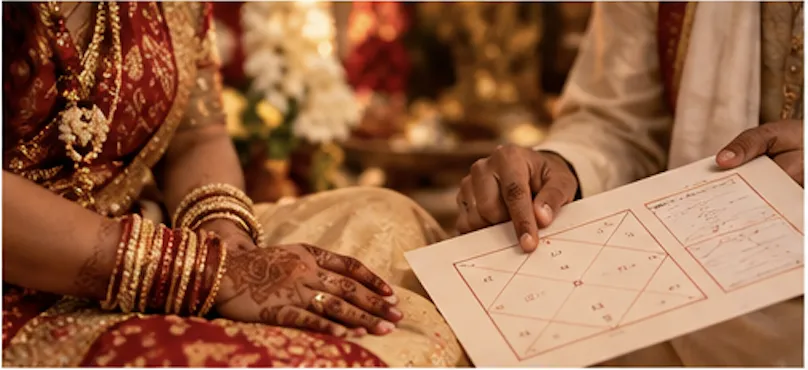
The muhurat, the auspicious time for the central rites, is usually the first practical question. Some families follow the bride's tradition here; some ask a practitioner to consider both charts together. North Indian families often favour evening or night muhurats, while many South Indian weddings take place in the early morning. Neither is more correct.
A good practitioner will look at the tithi (lunar day), nakshatra and lagna for a few candidate dates, avoid the traditionally unsuitable periods such as Kharmas, and then offer options that work for the venue and the guests. Practicality is part of good muhurat selection, not a compromise of it.
The aim is not to split the wedding in half, but to let each family recognise itself somewhere in the day.
Practical ways to blend
Many families hold separate pre-wedding events in each tradition, a mehendi and sangeet for one side, a nalangu or a gaye holud for the other, and then a single shared ceremony. Others ask the officiating priest to perform the central rites in one form while including one or two key customs from the other, such as the tying of the thali alongside the sindoor.
It is wise to involve both families' priests, or to choose one practitioner who knows both traditions and is willing to explain each step aloud in a language the guests understand. A short printed order of ceremony, with a sentence on what each rite means, helps guests from both sides feel included rather than lost.
The conversations that matter
The hardest moments are rarely about ritual. They are about whose relatives are seated where, which language the mantras are explained in, whether a custom one side treasures seems odd to the other. Elders may feel that their way is being diluted.
I find it helps to have one honest family meeting, with both sets of parents and the couple, before any bookings are made. List each family's non-negotiables, usually just two or three, and agree to honour them fully. Everything else can be flexible.
If you are planning such a wedding, begin with that meeting and a shared list. Once the families know what truly matters to each other, a practitioner can shape a ceremony that carries both traditions with dignity.
Vedic counsel and ritual are traditional and complementary practices — they sit alongside professional medical, legal and financial advice, never as a substitute for it.