
Questions to Ask Any Astrologer
Which tradition, which system, how they handle uncertainty and what they will not do. Seven questions that tell you a great deal about an astrologer.
 Jyotish Meenal Joshi
7 July 2026 · 3 min read
Jyotish Meenal Joshi
7 July 2026 · 3 min read
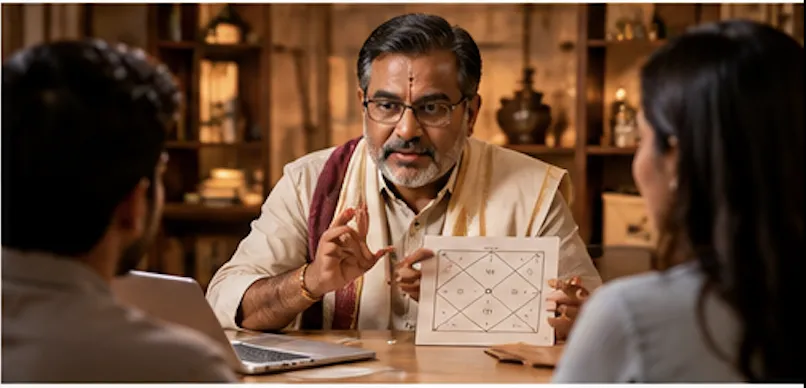
Clients rarely ask me anything about myself before a consultation. They give their birth details and wait. I understand the instinct; it can feel presumptuous to question someone whose work you do not fully understand. But you would ask a doctor or a lawyer about their training and approach, and the same courtesy applies here.
Here are the questions I would want a family member to ask any astrologer, including me.
About training and method
First, ask where and how they learned. Jyotish has been taught both in formal institutions and through family lineages, and both can produce excellent practitioners. What you are listening for is a willingness to name teachers and texts. Someone who studied the Brihat Parashara Hora Shastra and Phaladeepika under a named teacher for years will usually tell you so readily.
Second, ask which system they use. Most Vedic astrologers follow the Parashari system with the Vimshottari dasha, a 120-year cycle of planetary periods. Others use Jaimini methods, or Krishnamurti Paddhati, a more recent system focused on precise timing. None is wrong, but they work differently, and it helps to know which you are hearing.
Third, ask which ayanamsa they use, the correction applied to account for the slow shift between the tropical and sidereal zodiacs. Most Indian astrologers use Lahiri. A practitioner who can explain this briefly is usually one who understands their own calculations.
About how they work with uncertainty
Fourth, ask how they handle an uncertain birth time. An honest answer will involve some form of rectification and an admission that conclusions are provisional until the time is confirmed.
Fifth, ask what they will not do. A careful astrologer will tell you there are areas they will not predict, such as the date of someone's death, and that they will refer health, legal and financial matters to qualified professionals. If someone claims there is nothing outside their competence, take note.
The most reassuring answer an astrologer can give you is a clear account of what they will not claim.
About remedies and continuing contact
Sixth, ask about remedies before they are suggested. What kinds do they generally recommend? Are they mostly practices, such as mantra, charity or fasting, or mostly purchases? Do they sell gemstones or rituals themselves? Selling is not automatically a problem, but you should know whether the person advising you also profits from the advice.
Seventh, ask how often they think someone in your situation should consult. A good practitioner will usually suggest less contact than you expect, and will be comfortable with you going away to think.
You may also ask simply: what is your view of free will? Answers vary across the tradition, but the best ones leave room for your choices. Jyotish, as I was taught it, describes conditions and tendencies; what a person does with them remains their own.
You do not need to ask all seven in one breath. Choose two or three that matter to you, ask them at the start, and listen to the manner of the answer as much as its content. Patience, plain language and an absence of pressure tell you most of what you need to know.
Vedic counsel and ritual are traditional and complementary practices — they sit alongside professional medical, legal and financial advice, never as a substitute for it.