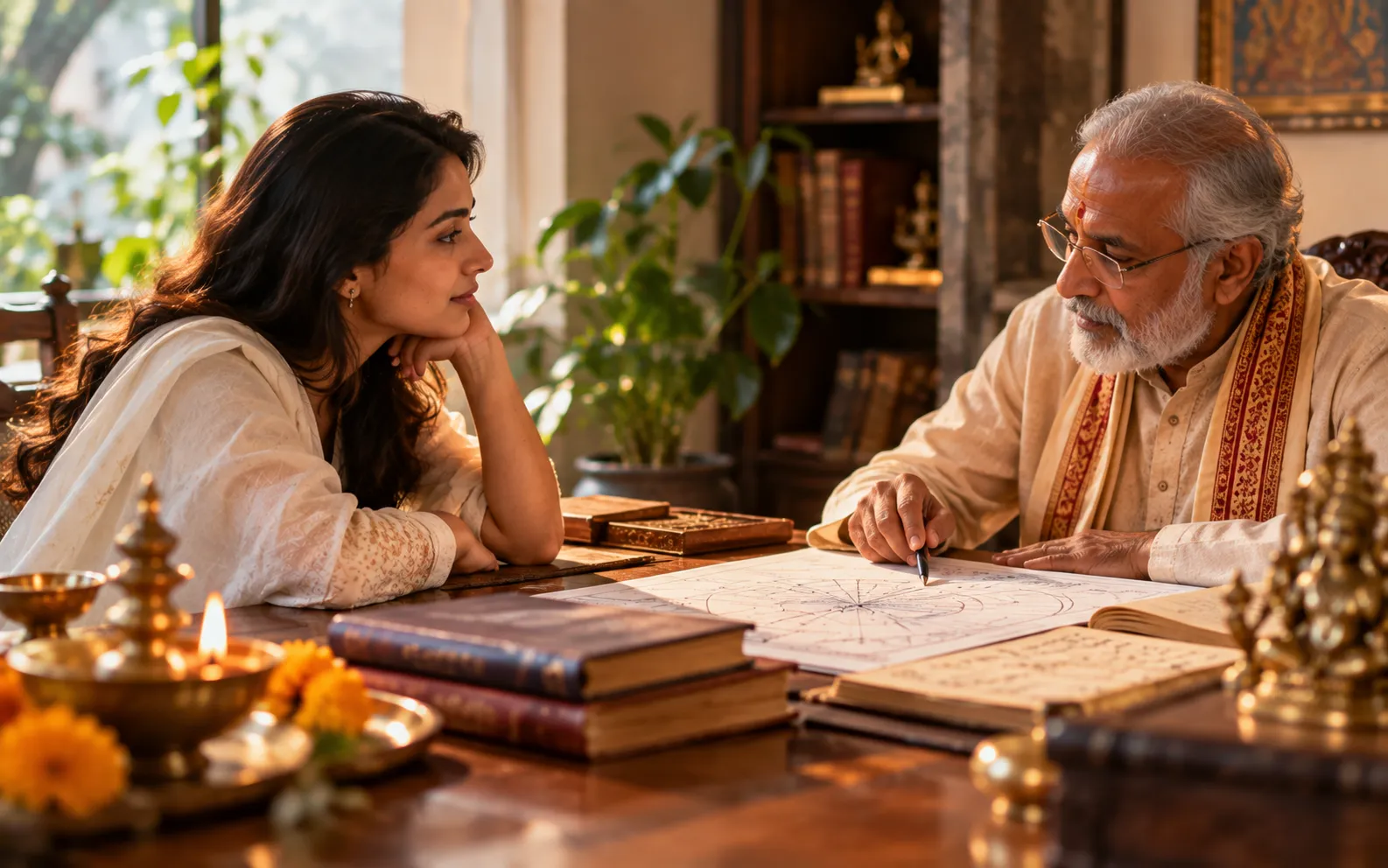

When Two Advisers Disagree
Two astrologers read the same chart and reach different conclusions. That is less alarming than it sounds, and it can even be useful.
 Jyotish Prakash Trivedi
26 May 2026 · 3 min read
Jyotish Prakash Trivedi
26 May 2026 · 3 min read

It happens more often than people expect. A family has a match read by the priest in Kolkata, and then by a cousin's astrologer in Bangalore. One says the guna score is fine and the marriage looks steady; the other raises a concern about the seventh house. Or a business owner hears two opposite views about whether this is the year to expand. They come to me, a third opinion, half hoping I will settle it.
Before anyone settles anything, it helps to understand why disagreement happens.
Why charts can be read differently
Some differences are technical. Astrologers may use slightly different ayanamsas, the correction between tropical and sidereal zodiacs, or different house systems. Some use the Parashari method, some Jaimini, some Krishnamurti Paddhati. In Bengal we have our own long tradition of panjika and reading practices. If the birth time is uncertain, even by fifteen minutes, two careful astrologers may in effect be reading two different charts.
Others are matters of emphasis. A chart contains many factors, and they rarely all point the same way. One reader gives weight to the dasha, another to a transit, a third to a yoga, a particular planetary combination. Jyotish is interpretive. Two physicians looking at the same scan can also disagree, and nobody concludes that medicine is meaningless.
How to compare the readings
The first step is to ask each adviser to show their reasoning. Which placements are they looking at? Which period? What exactly do they think it implies? Often the disagreement narrows considerably once it is specific. One astrologer may be talking about the next eighteen months, the other about the whole of life.
The second step is to check the inputs. Confirm that both used the same birth date, time and place. Surprising numbers of disagreements disappear at this stage.
The third is to notice the tone. If one reading is calm and specific and the other is alarming and vague, that difference is itself information.
When two careful readers disagree, the chart is telling you the matter is genuinely open, and that the decision is still yours to make.
What disagreement actually tells you
When two competent astrologers, working from the same data, reach different views, the honest conclusion is usually that the chart does not speak strongly on this question. That is not a failure. It means the matter is not overwhelmingly marked one way or the other, and other considerations should carry more weight: the practical facts, the people involved, your own judgement and that of those who know you.
This is especially true in marriage. A compatibility reading is one input among many. If two astrologers differ, spend more time on the things the chart cannot show: how the two families speak to each other, how the couple handle disagreement, whether their expectations of life are compatible.
What I advise against is consulting a fourth and fifth astrologer until someone says what you hoped to hear. That is not seeking guidance; it is seeking permission.
If you are caught between two readings now, write each conclusion in a single sentence, with the reasoning given. Check the birth details. Then set the readings aside for a week and ask what you would decide if neither existed. That answer often deserves more trust than either.
Vedic counsel and ritual are traditional and complementary practices — they sit alongside professional medical, legal and financial advice, never as a substitute for it.