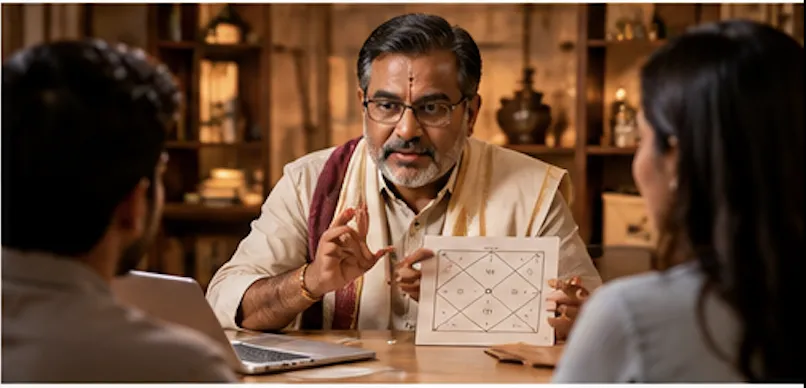

How Often Should You Consult?
Once a year is plenty for most people. When more frequent contact helps, when it quietly becomes a habit, and how to tell the difference.
 MyAstro7 Editorial
21 April 2026 · 3 min read
MyAstro7 Editorial
21 April 2026 · 3 min read

There is no rule in the classical texts about how often a person should see an astrologer. Historically most families consulted at fixed points: a child's birth, naming and thread ceremony, a marriage, a house, a death in the family. In between, the family priest might be asked about a festival date or a muhurat. Regular readings for their own sake are a fairly recent habit.
Today some people consult once in a lifetime, others every week. Both extremes are worth thinking about.
A reasonable rhythm
For most people, a thorough reading once, followed by a short review once a year, is ample. The structure of a Vedic chart does not change. What changes is the dasha, the long planetary period of your life, and the transits of the slower grahas, Jupiter, Saturn, Rahu and Ketu. Dashas last years, Saturn spends about two and a half years in a sign, Jupiter about one. An annual conversation, perhaps around your birthday or the new year in your family's calendar, comfortably keeps track of them.
Beyond that, consult when there is a specific need: a muhurat for a ceremony, a compatibility reading before marriage, or a major decision where timing is genuinely an open question. A practitioner on a retainer, as some families arrange, should still be working to this rhythm, with more contact around important events and very little in between.
When frequency becomes a problem
The signs of over-consulting are fairly easy to recognise once named. You ask the same question several times, hoping for a different answer. You seek guidance on small decisions, such as which day to send an email or whether to make a phone call. You feel anxious if you have not checked recently. You see more than one astrologer in the same month about the same matter.
When this happens, consultation has stopped informing your judgement and begun replacing it. It can also become expensive, and in the worst cases it leaves a person open to practitioners who encourage dependency.
A consultation should leave you better able to decide alone until the next one, not more eager for the next one.
What a good practitioner will say
A responsible astrologer will usually suggest less contact than you expect. They will answer a question once, clearly, and tell you when nothing in the chart is likely to change for a while. If you return repeatedly with the same concern, they may gently ask what is really worrying you, and suggest that someone else, a counsellor, a doctor, a financial adviser, may be better placed to help. Vedic guidance is complementary to that support, never a substitute.
They will also give you something to take away: an understanding of your current period, a simple practice, a date to revisit. The aim is your independence, not your return.
If you are unsure whether your own pattern is healthy, look back at the past year and count your consultations and the questions you asked. Group them by subject. If most were about the same matter, or about small daily choices, consider a pause of three months. Note what you would have asked during that time, and bring the list to your next annual review. You may find that most of the questions answered themselves.
Vedic counsel and ritual are traditional and complementary practices — they sit alongside professional medical, legal and financial advice, never as a substitute for it.