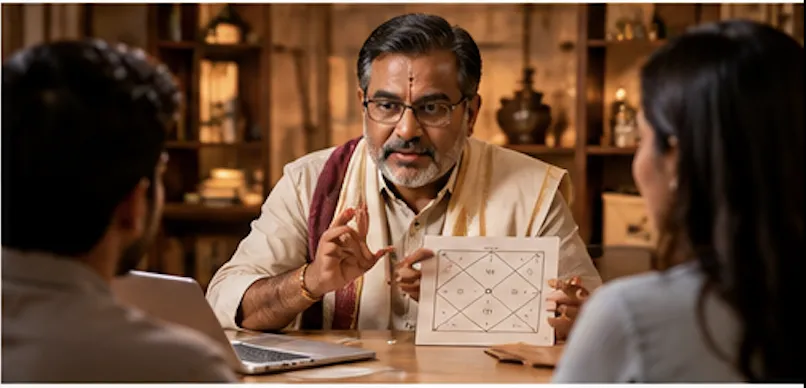

Remedies: What They Are For
Mantra, charity, fasting, ritual and gemstones each have a place in jyotish. None of them is a purchase that cancels the chart.
 Jyotish Kavita Sharma
13 August 2024 · 3 min read
Jyotish Kavita Sharma
13 August 2024 · 3 min read

Remedial astrology is my particular area, and it is also the part of jyotish most often misunderstood, sometimes by clients and sometimes by practitioners. People arrive believing a remedy is a kind of repair: a problem is found in the chart, a cure is applied, and the problem goes away. That is not how the tradition describes it, and believing it leads to disappointment, expense and occasionally harm.
So it is worth setting out plainly what remedies, upayas in Sanskrit, are for.
The kinds of remedy
The classical remedies fall into a few broad families. Mantra is the repeated recitation of a verse associated with a graha or deity, often a fixed number of times over a set period. Daana, charity, means giving particular things, such as black sesame or oil for Saturn or rice and white cloth for the Moon, usually on the graha's weekday and to people who need them. Vrata means a vow or fast, often on the weekday associated with the graha. Puja and homa are formal rituals, such as a navagraha shanti, performed by a priest with a clear sankalpa. And ratna, gemstones, are worn to strengthen the influence of a particular graha.
Of these, the first three are inexpensive and depend mainly on the person's own effort. That is not an accident.
What they are understood to do
In the tradition I was taught, remedies work primarily on the person performing them. A daily mantra builds attention and steadiness. Charity loosens the hold of a difficult period by turning the mind outwards. A weekly fast is a small, repeated act of discipline. Through these, a person meets difficult conditions with more composure and makes better choices within them.
A remedy is not a payment that cancels the chart; it is a practice that changes how you meet it.
Puja and homa add the dimension of formal acknowledgement, a family gathering to name a concern before the sacred fire. Many find this deeply meaningful. It should be done sincerely and proportionately, not repeated out of anxiety.
Gemstones need the most caution. Wearing a stone strengthens a graha's influence, and if the graha is a difficult one for your chart, this can be counterproductive. A stone should be recommended only after careful analysis, never casually, and never in a hurry. They are also the remedy most often tied to commercial interest.
What they cannot do
No remedy replaces medical treatment, legal advice or financial planning. If a concern touches health, money or law, see the appropriate professional first; Vedic remedies sit alongside that help, never in place of it. Nor can remedies guarantee an outcome, whether a marriage, a job or a recovery, and anyone who promises otherwise is claiming more than the tradition does.
A good remedy has a few marks. It is explained, so you know why it is suggested. It is proportionate, not out of scale with the concern. It is mostly something you do rather than something you buy. And it is optional; declining it should not bring a warning of disaster.
If you have been given remedies, choose the one you can actually sustain, usually a short daily mantra or a simple weekly act of charity, and keep it consistently for forty days before judging it. If you are unsure whether a recommendation is sound, a second practitioner can review it with you.
Vedic counsel and ritual are traditional and complementary practices — they sit alongside professional medical, legal and financial advice, never as a substitute for it.