The Four Vedas: A Short Orientation
Rig, Yajur, Sama and Atharva: what each Veda contains, how they were preserved, and why most rituals still draw on all four.
 MyAstro7 Editorial
6 August 2024 · 3 min read
MyAstro7 Editorial
6 August 2024 · 3 min read
The Vedas are the oldest body of Sanskrit literature and the foundation of the ritual traditions described throughout this journal. They are usually counted as four: the Rigveda, Yajurveda, Samaveda and Atharvaveda. Many people know the names but have never been told plainly what each contains or how they relate.
This is a brief orientation, not a scholarly survey. It aims to give a reader enough of a map to understand why a priest recites what they recite.
What each Veda is
The Rigveda is a collection of over a thousand hymns, suktas, arranged in ten books called mandalas. The hymns are addressed to deities such as Agni, Indra, Varuna, Soma and the Ashvins, and include some of the most philosophically searching verses in the tradition, such as the Nasadiya Sukta on the origin of the world. Its verses are called richas.
The Yajurveda is the Veda of ritual action. It contains the formulas, yajus, spoken while performing the physical acts of a sacrifice. It exists in two main branches, the Krishna (black) and Shukla (white) Yajurveda. The Sri Rudram, widely chanted in Shiva worship, belongs to the Krishna Yajurveda.
The Samaveda is largely drawn from Rigvedic verses set to melody, saman, for singing during rituals. It is the root of much Indian musical thought. The Atharvaveda, often treated separately in older classifications, contains hymns for domestic life, healing, protection, marriage and kingship, along with significant philosophical material.
Layers within each Veda
Each Veda is itself layered. The Samhitas are the core collections of hymns or formulas. The Brahmanas explain and elaborate on ritual procedure. The Aranyakas, the forest texts, reflect on the inner meaning of ritual. The Upanishads, the latest layer, turn toward questions of the self, consciousness and ultimate reality. When people speak of Vedanta, the end of the Veda, they mean this Upanishadic layer and the traditions of thought built on it.
Oral preservation
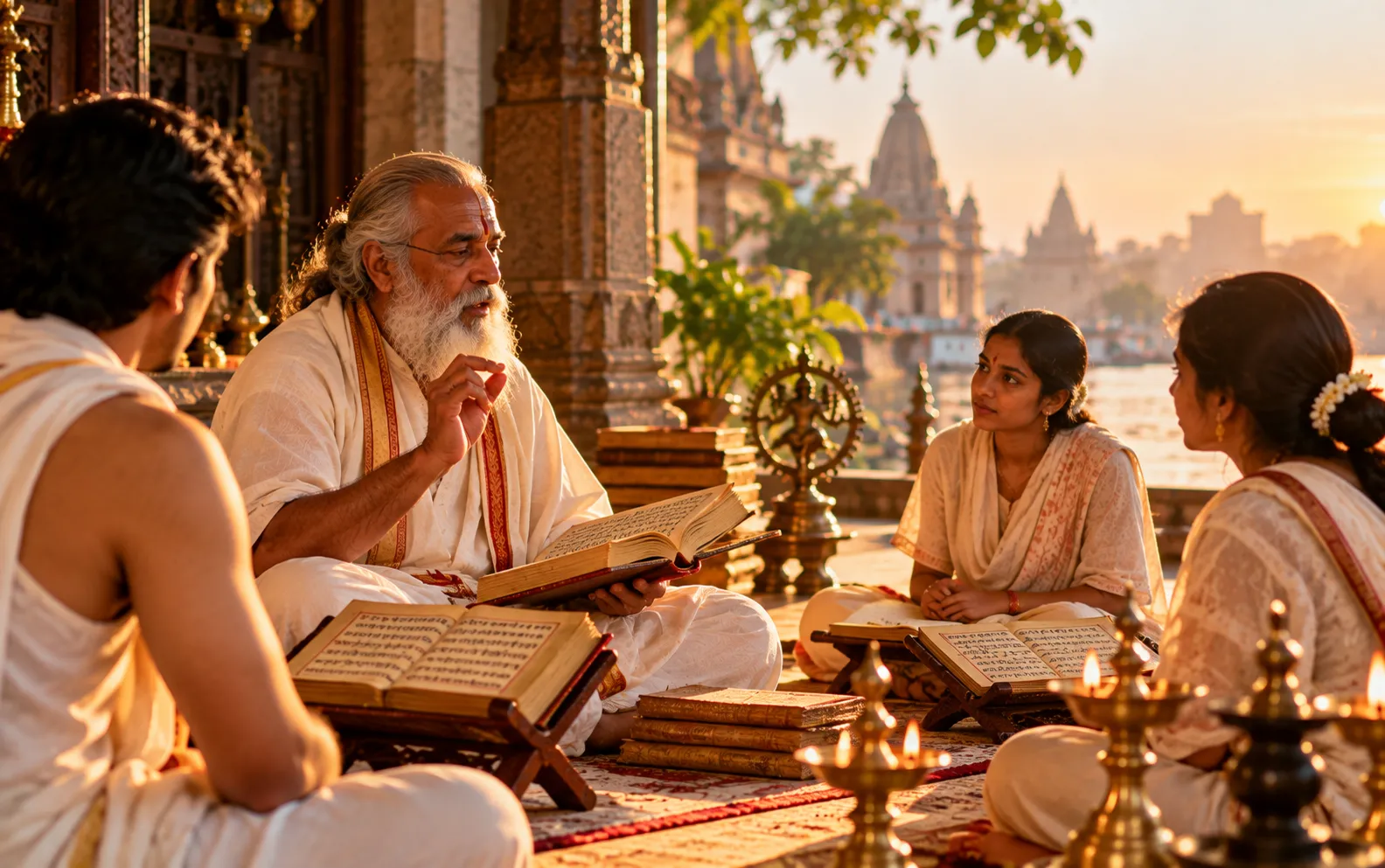
The Vedas were transmitted orally for many centuries before being written down, and they are still taught orally in traditional schools called pathashalas. To prevent error, students learn the texts in several patterns, including padapatha (word by word), kramapatha (in overlapping pairs) and more complex forms such as jata and ghana, in which words are repeated forwards and backwards in fixed sequences. UNESCO has recognised Vedic chanting as an element of intangible cultural heritage.
The Vedas were kept not in libraries but in the trained memory of people.
How they appear in practice
A single household rite often draws on more than one Veda. A wedding may include Rigvedic verses, Yajurvedic formulas and procedures from a Grihya Sutra, the domestic ritual manual associated with a particular Vedic branch, or shakha. Families often belong to a particular shakha by lineage, and a careful priest will ask about it.
It is worth adding what the Vedas are not. They are not a book of predictions, and they are not the source of most popular astrology, which developed later within Jyotisha, one of the six Vedangas, the auxiliary sciences that support Vedic study.
If you want to begin reading, start with a good translation of selected Rigveda hymns and one short Upanishad, such as the Isha or Kena, with a reliable commentary. Read slowly. And if a priest recites at your family's next ceremony, ask which Veda the verses come from. Most will be glad you asked.
Vedic counsel and ritual are traditional and complementary practices — they sit alongside professional medical, legal and financial advice, never as a substitute for it.