Sankalpa: The Statement of Intention
Every puja begins with a sankalpa, a formal statement of who is acting, where, when and why. Why this short recitation is the foundation of a ritual.
 Acharya Vishwanath Iyer
15 August 2024 · 3 min read
Acharya Vishwanath Iyer
15 August 2024 · 3 min read

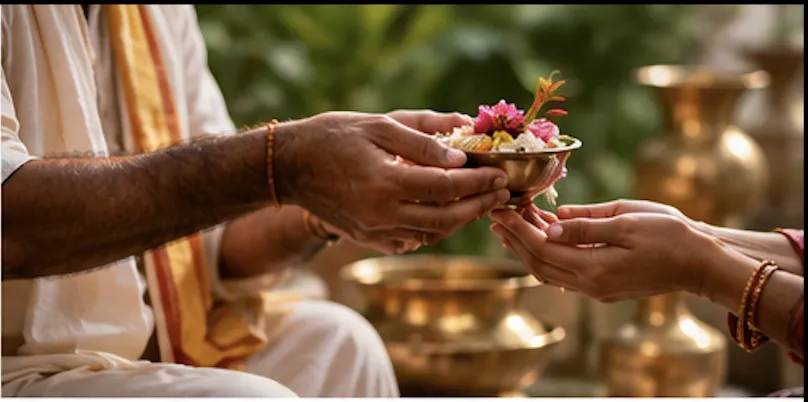
If you have attended a puja, a havan or a samskara, you will have seen the moment near the beginning when the priest asks the yajamana, the person for whom the ritual is performed, to hold a little water, rice and perhaps a flower in the right palm. The priest then recites a long sentence in Sanskrit, pausing to ask for a name, a gotra and sometimes a wish. At the end the water is released onto the ground or into a plate. This is the sankalpa, and nothing in the ritual that follows is complete without it.
Sankalpa means a resolve or intention. It is a formal declaration that a specific person, at a specific place and time, is undertaking a specific act for a specific purpose. It turns a set of actions into a ritual that belongs to someone.
What the sankalpa contains
The structure is remarkably precise. It begins by locating the moment in cosmic and calendrical time: the present age, the Kali Yuga; the current samvatsara, or year, in the sixty-year cycle; the ayana, whether the Sun is moving north or south; the ritu, or season; the month; the paksha, the bright or dark half of the lunar month; the tithi, the lunar day; the weekday; and often the nakshatra, the Moon's lunar mansion, of that day.
It then locates the place, beginning broadly with Jambudvipa and Bharatavarsha and narrowing towards the region and the particular town or riverbank. It names the person, their gotra, the ancestral lineage traced to a rishi, and sometimes their family members. Finally it states the purpose: the welfare of the household, the removal of obstacles, gratitude for a blessing, the peace of an ancestor, and the name of the ritual to be performed.
Hearing a sankalpa recited in full is a little like reading a carefully drafted address: it moves from the vast to the particular until it arrives at one family, on one morning, making one offering.
A sankalpa does not ask the gods for anything; it states, honestly and precisely, what you are about to do and why.
Why it matters
In the shastric understanding, intention gives an action its direction. The same offering into a fire can be a daily devotion, a thanksgiving, or a rite for an ancestor; the sankalpa determines which it is. It also establishes responsibility. The yajamana, by taking the water and releasing it, accepts the ritual as their own. The priest performs it on their behalf, but it is the yajamana's act.
This is why a careful priest will ask for correct names and gotra, and will take a moment to confirm the purpose with you before beginning. If your family does not know its gotra, which is common, the tradition offers a solution: Kashyapa gotra is generally used, since Kashyapa is regarded as a progenitor of all beings.
What a sankalpa is not
It is not a bargain. Traditional understanding does not hold that a correctly worded sankalpa guarantees a result, and a responsible priest will not suggest that it does. It is a statement of sincere intention, and the ritual is an offering. Outcomes in life remain shaped by many things, including one's own efforts and, where relevant, professional help.
Making it your own
If you are arranging a ritual, it helps to think in advance about why you want it performed, and to be honest about it. You might share the purpose with the priest beforehand, ask for the names of family members to be included, and ask for the sankalpa to be explained in your own language after it is recited. Many priests are glad to do this. When you hold the water in your palm, you are not merely following a step; you are putting your name to what follows.
Vedic counsel and ritual are traditional and complementary practices — they sit alongside professional medical, legal and financial advice, never as a substitute for it.