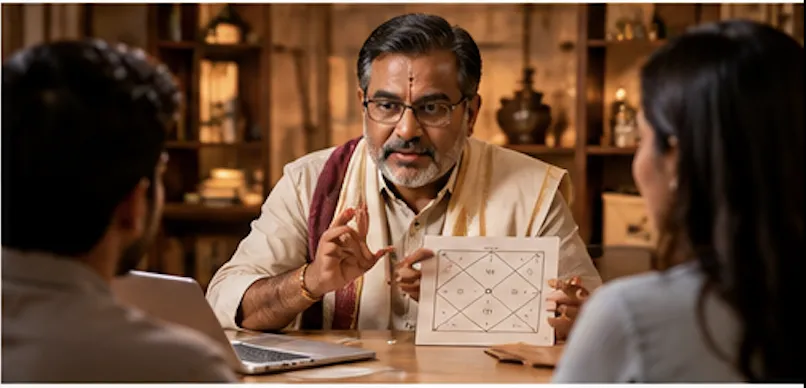

The Value of a Second Opinion
Two honest jyotishis may read the same chart differently. That is not a flaw in the tradition, and knowing why helps you weigh any reading wisely.
 Jyotish Kavita Sharma
22 August 2024 · 3 min read
Jyotish Kavita Sharma
22 August 2024 · 3 min read

Clients sometimes come to me apologetically. They have already consulted another astrologer, they say, and they are not sure whether it is proper to ask again. I always tell them the same thing: it is entirely proper, and on important matters it is often wise.
In medicine, a second opinion is routine before major surgery. In law, a careful client may ask a second counsel to look at a contract. Jyotish deserves the same seriousness, partly because it is an interpretive discipline and partly because the decisions people bring to it, marriage, relocation, a child's education, matter so much.
Why readings differ
Two practitioners working from the same birth details may reach different emphases for several reasons. They may use different ayanamsha, the correction that converts tropical positions to the sidereal zodiac used in Vedic astrology; Lahiri is most common, but not universal. They may give different weight to divisional charts such as the navamsha (the ninth-harmonic chart used for marriage and inner nature). One may emphasise dasha periods, another transits. Regional schools, from Kerala to Bengal, carry their own techniques.
And then there is simple human judgement. A chart is a set of factors, some supportive and some challenging. Deciding which ones dominate is an act of interpretation, not arithmetic.
When a second opinion helps most
I would suggest one in three situations. First, when a reading has frightened you, particularly if it named a dosha (an affliction) such as Mangal dosha and recommended costly remedies. Fear deserves a calm second look. Second, when the decision is large and difficult to reverse, such as a marriage alliance or a change of country. Third, when the first reading felt vague, or did not engage with your actual question.
It is also worth checking the birth time. Many apparent disagreements turn out to come from a lagna on the cusp between two signs, where a few minutes of uncertainty change the picture. A practitioner may suggest birth time rectification, refining the time using known life events, before saying anything firm.
When two careful readers agree, you can hold the conclusion with more confidence; when they differ, you have learnt where the real uncertainty lies.
How to ask well
You need not tell the second practitioner everything the first one said, at least not at the outset. Let them read the chart fresh. Afterwards, it is perfectly reasonable to say, another reader saw this differently, can you explain your view? A good jyotishi will engage with the point rather than dismiss a colleague.
Be cautious of anyone who insists that every other reading is wrong, or who uses a second opinion as an opportunity to sell a larger remedy. Disagreement between practitioners is normal; contempt is not.
Holding the results
Where two readings broadly agree, take that as a reasonable basis for reflection. Where they differ, do not simply pick the more pleasing answer. Notice the area of disagreement and treat it as a place where the chart, or the birth data, gives no clear signal. In those areas, ordinary judgement, the advice of people who know you, and practical facts should carry more weight.
If you are carrying a reading that troubles you, bring the chart and your question to another practitioner without embarrassment. Asking again is not disloyalty. It is care.
Vedic counsel and ritual are traditional and complementary practices — they sit alongside professional medical, legal and financial advice, never as a substitute for it.