

The Guru–Shishya Tradition
For three thousand years the Vedas were carried in memory, from one teacher to one student. What that relationship was, and what it was never meant to be.
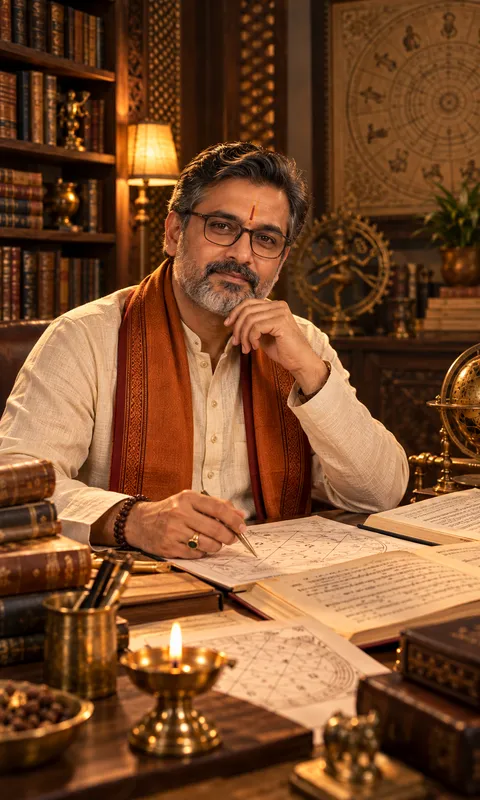 Pandit Shivkumar Iyer
6 May 2025 · 3 min read
Pandit Shivkumar Iyer
6 May 2025 · 3 min read

The Vedas were written down very late. For most of their history they lived only in the voices of people who had memorised them, syllable by syllable, from a teacher who had memorised them from his. That chain, the parampara, is the reason a hymn composed thousands of years ago can still be recited today with its pitch accents intact.
I learned in such a chain, in Kanchipuram, and I still teach in one. Let me describe it as it is, rather than as it is sometimes romanticised.
How knowledge actually passed
The relationship traditionally began with upanayanam, the sacred thread ceremony, which marked a child's entry into formal study. The student then lived with or near the teacher in a gurukula, learning not in lectures but in repetition. A Vedic text was learned in its continuous form, the samhita patha, and then in increasingly elaborate rearrangements: word by word in the pada patha, in overlapping pairs in krama patha, and in the intricate weaves called jata and ghana. These methods exist for a single reason. If one recitation drifts, the others expose the error. They are an error-correcting code built out of human memory.
Alongside the text, the student absorbed how a ritual is conducted, how a sankalpa is framed, how to sit, when to be silent. Much of this was never written anywhere. It was seen.
What the guru is for
The word guru is often said to mean "one who dispels darkness". A more modest reading is simply "heavy", one who carries weight. Either way, the traditional understanding is that the teacher transmits something larger than himself. Guru Purnima, the full moon of Ashadha, honours Vyasa, the compiler of the Vedas, as the first teacher, and every teacher since is understood as standing in his place for a while.
A good teacher points beyond himself; one who asks only to be looked at has misunderstood the role.
That is the safeguard within the tradition. The guru deserves respect because of what he carries, not because of who he is. Students were permitted, and in the Upanishads even encouraged, to question. The great dialogues are full of disagreement.
Where it can go wrong
It would be dishonest not to say that a relationship of deep trust can be abused. Unquestioning obedience, demands for money or property, isolation from family, secrecy about one's own conduct: none of these are part of the parampara, and none should be tolerated in its name. A teacher who discourages you from seeking medical, legal or financial advice is not acting within the tradition.
For most families today, the guru-shishya relationship appears in smaller forms: the pandit who has served three generations of a household, the teacher who prepares a boy for his upanayanam, the elder who explains what a ritual means. These still matter, and they still work best when both sides understand the obligation runs in two directions.
If you are choosing a teacher for yourself or a child, watch how they treat their own teachers and how they answer a question they cannot answer. Ask who taught them and whether they will name their lineage. Then give the relationship time; the tradition always assumed that learning of this kind takes years, not weekends.
Vedic counsel and ritual are traditional and complementary practices — they sit alongside professional medical, legal and financial advice, never as a substitute for it.