Vivah Sanskar: The Seven Steps
Saptapadi is the legal and spiritual heart of a Hindu wedding. Here is what each step says, and why the vows still read well today.
 Acharya Ramesh Shastri
7 February 2026 · 3 min read
Acharya Ramesh Shastri
7 February 2026 · 3 min read

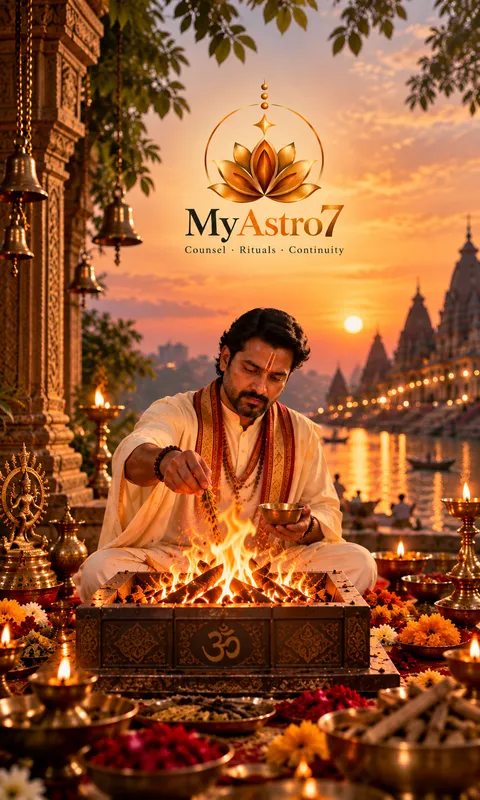
A Hindu wedding can run for days and involve dozens of customs, many of them regional and delightful. But if one asks which moment actually makes the marriage, the classical answer is clear. It is saptapadi, the seven steps the couple take together near the sacred fire. Indian law, in the Hindu Marriage Act, recognises this too: where saptapadi is part of the customary rite, the marriage is complete when the seventh step is taken.
In Varanasi, where I have conducted vivah for most of my working life, families sometimes ask me to shorten the ceremony. There is a great deal that can be trimmed with care. Saptapadi is not among those things.
The sequence around it
The vivah sanskar begins well before the seven steps. There is the sankalpa, the declaration of intention; kanyadaan, in which the bride's parents formally entrust her; panigrahana, the taking of the hand; and the offerings into Agni, the fire, which is treated as the witness to the marriage. Laja homa, the offering of puffed rice by the bride with her brother's help, is common in many families.
The pheras, the circlings of the fire, are often confused with saptapadi. In some traditions they are combined; in others they are distinct. A practitioner should explain which form your family follows, rather than leave you to guess on the day.
What the seven steps say
With each step, the groom recites a short verse and the couple commit to a shared aim. The first step is for nourishment, the second for strength, the third for prosperity, the fourth for happiness, the fifth for children and family, the sixth for living through the seasons together, and the seventh for friendship. The final verse says, in essence: with these seven steps, become my friend.
It is worth noticing how practical the list is. Food, health, livelihood, contentment, family, endurance and companionship. There is nothing in it about fate or fortune. It reads like a sensible agreement between two adults about the life they are about to build.
The seventh step asks for friendship, and that tells you what the whole ceremony was for.
Translation, language and understanding
Many couples now ask for the verses to be explained in English or in their own language as the ceremony proceeds. I encourage this. The Sanskrit should be recited correctly, because the form of the rite matters to the tradition, but nothing is lost if the couple also understand what they are promising. In my experience, the steps are more memorable for it.
Some families also ask whether the bride may speak her own verses or whether the order of leading can be shared. Regional practice varies, and there are respectable precedents for both partners participating actively. These are conversations to have with your officiant before the day, not in the mandap.
What the ceremony cannot promise
No ritual guarantees a happy marriage, and an honest priest will not say otherwise. Kundali matching, muhurat selection and a beautifully performed vivah are traditional supports. What sustains a marriage afterwards is the ordinary work the seven steps describe. If there are legal questions about registration, especially for couples marrying abroad or across religions, a lawyer is the right adviser.
If you are planning your wedding, ask your priest for a written outline of the ceremony a few weeks ahead, including which parts are essential and which are customary. Read the seven verses together beforehand. And protect at least twenty unhurried minutes for saptapadi in the schedule, however crowded the day becomes.
Vedic counsel and ritual are traditional and complementary practices — they sit alongside professional medical, legal and financial advice, never as a substitute for it.